





The World’s #1 Decarbonised Debit Registry

Trusted, Data-Backed Climate Assets: Build confidence with a climate asset registry anchored in verified, historical data. Unlike voluntary markets that rely on speculative future projections, our assets are generated from audited, real-world corporate actions, ensuring high traceability and trust.

image

Why Decarb Debits?

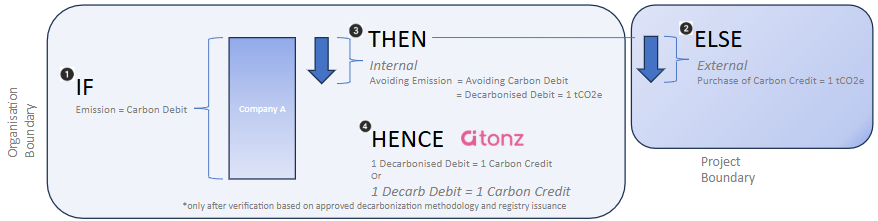
Decarbonised Debits and traditional carbon credits differ significantly in their origins, verification methods, and underlying data structures:

img1

Internal vs External Action

A traditional carbon credit represents emissions reductions or removals achieved outside of an organisation's boundary (an "outside-in" approach). In contrast, a Decarbonised Debit is registered when an organisation avoids emissions internally at the source (an "inside-out" approach), such as through efficiency gains or renewable energy use.

img2

Historical vs Projected Data

Decarbonised Debits are built on historical, auditable data reflecting real-world corporate actions that have already occurred. Traditional carbon credits are often criticised for relying on speculative, future-based projections.

img3

Boundary and Standards

Decarbonised Debits are measured at the organisational level using the ISO14064-1 standard (verification approach), whereas traditional carbon credits are measured at the project level using the ISO14064-2 standard (validation approach).

img4

Traceability

Because Decarbonised Debits are tied to accessible organisational activities (like a manufacturing site), they offer high traceability. Traditional carbon credits often have low to moderate traceability, especially for hard-to-access projects such as afforestation.

img5

Security Infrastructure

Decarbonised Debits is designed to link blockchain technology (the Polygon network) to ensure data security and immutability, a feature generally lacking in standard carbon credits.

Despite these structural differences, both instruments hold the same equivalent climate value: one Decarbonised Debit is equal to one carbon credit (representing 1 tonne of CO2e avoided), providing a credible basis for offsetting unmitigated emissions.

The process to register and utilise a Decarbonised Debit follows a structured five-step

Decarbonised Debits Registry Flow

designed to ensure credibility and traceability:

01. Avoidance

Identify Emission Avoidance Initiatives: The organisation then identifies and adopts "inside-out" decarbonization technologies or initiatives to reduce internal emissions. As noted earlier, these can include adopting renewable energy, digitalisation, or waste diversion.

02. Verification

Independent Verification: Before any assets are registered, the achieved emission avoidances must be independently verified using historical data, adhering to the ISO14064-3 standard.

03. Registration

Once verified, the avoided emissions are converted into carbon units. Specifically, every 1 tonne of CO2e avoided translates to registering 1 Decarb Debit. The newly registered debits are officially entered into the Aitonz’s Decarbonised Debit Registry.

04. On-Chain

Trade, Transfer, and Offset at Peer Marketplace: Finally, organisations can trade, transfer and offset their Decarb Debits on a third-party peer-to-peer marketplace. This provides liquidity and allows the organisation to transfer their climate achievements across their supply chain or hold them as valuable climate assets.

Contact Us

Integration with the Polygon blockchain

An Aitonz-backed marketplace that operates as an Ethereum Layer 2 (L2) scaling solution, improving the security of carbon assets through several key mechanisms at Peer Marketplace:

#1 Data Immutability

By integrating a blockchain-backed registry at the Peer Marketplace, the third-party platform ensures that the data recording each Decarbonised Debit is immutable, meaning it cannot be altered or tampered with once it is entered.


#2 Preventing Double-Counting

Recording each digital carbon unit on this immutable ledger ensures that the same carbon asset cannot be claimed, sold, or retired more than once.

#3 Full Traceability and Transparency

The blockchain creates a highly traceable and transparent record of corporate decarbonisation activities, securely tracking assets from issuance through transfer, trading, or retirement.

By anchoring historically audited data to this secure infrastructure, Polygon helps eliminate the trust issues and vulnerabilities often associated with traditional, projection-based voluntary carbon markets.

Contact Us

Decarbonised Debit is built upon audited, real-world organisational decarbonisation actions, ensuring transparency and trust.

Register for the carbon accounting workshop!